Menu

Oxide wafer coatings: their properties and application methods

14-10-2021
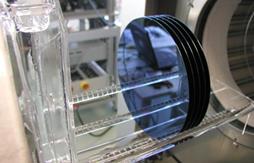
When applied to a wafer, an oxide coating adds a dielectric or passivation layer, needed to give a semiconductor, MEMS or BioMEMS device its desired electrical properties. In our “Oxide wafer coatings: their properties and application methods” article, we discuss the two most common oxidation processes – Atmospheric Thermal Oxide (ATOx) and Plasma Enhanced Chemical Vapour Deposition (PECVD) – and provide examples of applications that benefit from both. We discuss oxide growth rate, and how it is influenced by temperature, the presence of other chemicals (water/steam in the case of wet ATOx), doping and crystal orientation. Also, did you know, that during the oxidation process, oxide grows into the wafer as well as onto its surface. For silicon, the ratio is about 46% into the surface and 54% on top of the original surface. In other words, the overall wafer thickness does not increase by the depth of the oxide layer, as some of the Si is consumed during the oxidation process. Inseto produces and supplies an extensive range of high-quality semiconductor wafers and substrates worldwide, used for production and research purposes.
ENQUIRY FORM

More News

  • Inseto to Exhibit at SEMICON Europa 2025 – Book Your Appointment Today!

  • Inseto’s Geographical Remit Extends: Now Supplying Wafer Dicing Blades in Austria, Germany, Ireland, the Netherlands, Portugal and the UK

  • Inseto Welcomes Adam Wood to Our Technical Sales Team

  • Inseto Awarded ISO 14001 Accreditation